Meta says you need 50 conversions a week. Most Indian accounts don't.
About 50 a week, Meta says, or the system is guessing. Divide your weekly budget by cost per result times 50 to see how many ad sets you can afford. If you run more, merge them, or optimise for an earlier event such as add to cart or a qualified lead.
In its peak-season guide on 21 October 2026, Meta put it bluntly: “Give each ad set enough volume to learn from. Roughly fifty conversions a week. Below that the system is guessing.”
It even put a cost on it: “In our analysis, ad sets under that threshold ran about 28% more expensive per purchase.”
Most Indian accounts we take over are nowhere near 50. They run six, eight, ten ad sets on a budget that could properly feed two. Every ad set gets a few conversions a week, none of them learns, and the whole account pays the 28%.
Why does 50 matter?
Each ad set learns on its own. It needs to see enough people convert to work out who else will. Meta’s help page says an ad set usually leaves the learning phase after about 50 results in the week after its last significant edit. Until then, delivery jumps around and results cost more.
Split your budget across too many ad sets and you split the learning too. Ten ad sets with five purchases each is not the same as one ad set with fifty. The first is ten systems guessing; the second is one that knows.
How many ad sets can you afford?
Meta gave the formula in the same guide:
Weekly budget ÷ (cost per result × 50) = the most ad sets your budget can support.
Here is what that means at around ₹5 lakh a month:
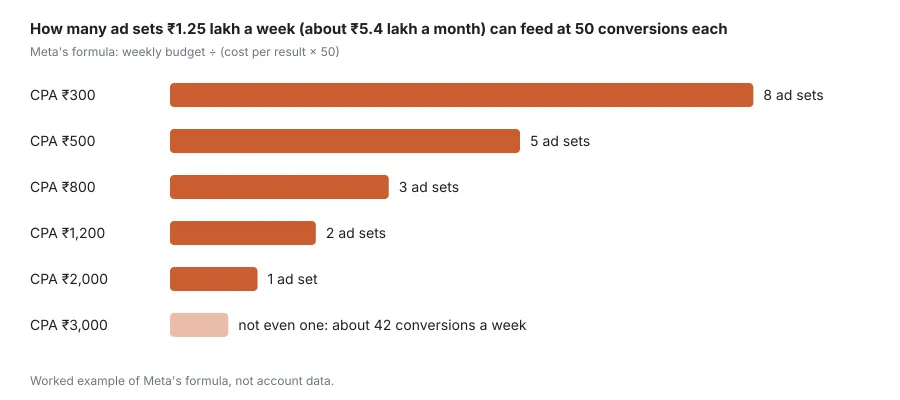
At a ₹1,200 cost per purchase, ₹1.25 lakh a week feeds two ad sets. Not eight. At ₹3,000, it does not fully feed even one. That is normal for high-ticket products and services in India, and it is why so many of these accounts sit in “Learning limited” for months.
What should you do about it?
1. Merge ad sets
Run the formula on your own numbers. If it says two, run two. Most splits are not worth what they cost:
- Ad sets split only by age or gender can now become one, with an audience on each creative. See age and gender per creative.
- Ad sets split by interest are mostly pointless now that Meta treats interests as suggestions, as we explain in what’s left of Meta targeting.
- Ad sets split by creative should be one ad set with several creatives. Meta will put the money behind the winners.
Keep a split only where it changes what Meta must do: a different country, a different language, or a genuinely different product or price. Our campaign structure post shows the testing and scaling set-up we use.
2. Optimise one step earlier
If even one ad set cannot reach 50 purchases a week, give Meta an event it can see more often. Add to cart, initiate checkout, or a qualified lead. Run on that until the ad set is getting comfortably more than 50 a week, then move up to purchase.
There is a trade-off. Earlier events bring cheaper, lower-intent people, so check that they still buy. And for lead businesses, a qualified lead is far better than a raw form fill, because it teaches Meta who is worth talking to. We set out how in teaching Meta which leads are good.
Is 50 a hard rule?
No. It is Meta’s guide to how delivery learns, not a pass mark. Some ad sets settle below it, and at a high cost per purchase, 50 a week is simply a large budget commitment. But the direction is clear: fewer, better-fed ad sets beat many hungry ones. If your account runs more ad sets than the formula allows, that is the first thing to fix.
Ask me anything about this post
Frequently asked questions
Why does Meta want 50 conversions a week?
Because each ad set learns from its own conversions. Meta says an ad set usually leaves the learning phase after about 50 results in the week after its last significant edit. Below that, delivery is less stable and results usually cost more.
How much more do ad sets under 50 cost?
Meta's October 2026 peak-season guide says ad sets under the threshold ran about 28% more expensive per purchase in its analysis. It did not publish how it measured that, so treat it as a direction, not a promise.
How many ad sets can my budget support?
Divide your weekly budget by your cost per result times 50. At ₹1.25 lakh a week and a ₹1,200 cost per purchase, that is two ad sets. Anything more and each ad set is starved.
What if even one ad set cannot reach 50?
Optimise for an earlier, more frequent event, such as add to cart, initiate checkout or a qualified lead, until volume allows. Then move to purchase. Watch quality, because earlier events bring cheaper, lower-intent people.
Sources
- Meta says ad sets under 50 weekly conversions cost 28% more per purchase — PPC Land, accessed 6 Nov 2026
- About the learning phase — Meta Business Help Centre, accessed 6 Nov 2026
- 50 conversions per week and the Meta learning phase — RocketShip HQ, accessed 6 Nov 2026
Related reading
-
The Meta campaign structure working for us in October 2026
Two campaigns, one ad set each: a scaling campaign for proven ads and a testing campaign for the next one. Real numbers from a live account.
-
Andromeda 2.0, GEM and GenRecs: what Meta's ad AI means for creative
What Meta's ad systems Andromeda, GEM and generative retrieval actually do, what changed in 2026, and why distinct creative concepts now beat more ads.
-
Meta's creative diversity score: what Low, Medium and High mean
Ads Manager now rates each ad set's creative diversity as Low, Medium or High. How it is worked out, what it misses, and how much to care.
Ask this site
Answers are generated from published posts on this site only. Check the cited post before acting on anything.