Optimising Meta for leads is the most expensive cheap thing you can do
Stop optimising for the lead. Send Meta what happens after it: mark each lead as qualified or purchased in your CRM, send those stages back through the Conversions API with the purchase value, and optimise the campaign for the stage that pays. Meta then looks for people who buy, not people who fill forms.
Most lead generation accounts we take over were set up the same way: a Meta campaign optimised for leads, a cost per lead the previous agency was proud of, and a sales team drowning in people who never pick up.
Optimising for the lead is the most expensive cheap thing you can do. Here is why, and what we do instead, using the leads CRM we built for Meta ads. If you want to follow along in your own account, start for free.
Why does optimising for leads go wrong?
Meta optimises for exactly the event you give it. Tell it you want leads and it finds the people most likely to submit a lead. It has no idea whether they buy, because nobody tells it.
That gap shows up in two common set-ups.
Leads on WhatsApp. Leads arrive for ₹15 to ₹20 each. It looks brilliant on the dashboard. But a WhatsApp click costs the person nothing, so Meta learns to find people who tap. You get volume, your team spends its day chasing it, and most of it drops. Meanwhile Meta thinks the campaign is going very well, because it is delivering exactly what you asked for. To grow, you hire more people to work the list by hand. The campaign never gets better on its own, and scaling it means scaling headcount.
Leads on a form or a Google Sheet. Better. A form takes effort, so cost per lead rises and quality rises with it. But it stops there. Meta learns which people complete forms. It still does not know which of them booked the place or bought the product, so lead quality on day 90 is no better than on day one.
In both cases the learning stops at the form. Everything that tells you a lead was good happens after it, out of Meta’s sight.
What should you optimise for instead?
The furthest stage in your funnel that happens often enough and soon enough for Meta to learn from.
- Qualified lead, when sales take weeks. Your team marks a lead as qualified after the first call, and Meta optimises for that.
- Purchase, when most purchases happen within about seven days of the lead. Then there is no reason to stop at the lead at all. We run lead campaigns optimised for purchase in those accounts.
Meta’s guide for its Conversion leads goal suggests at least 200 leads a month, CRM updates at least daily, and a target stage that between 1% and 40% of leads reach. If you are below that, pick a stage closer to the form until volume grows.
How do you send Meta what happened to each lead?
Through the Conversions API. Every time a lead changes stage, you send Meta an event with the lead’s ID: this lead was qualified, this one purchased, for this much. Meta matches it to the person who saw the ad, and the next auction is bid on people who look like your buyers, not your form fillers.
Why did we build our own CRM for this?
Because we could not find one that did the job. As an agency, we went looking for a CRM to sit between our clients’ lead forms and Meta, and we tried every option we could find. Some were very expensive. Some charged per ad account, which punishes an agency for growing. Some stored leads perfectly well but never sent a single signal back to Meta. Others sent signals but could not be bent to the way our clients actually sell: a birthday enquiry, a corporate booking and a follow-up two months out are not the same pipeline.
What we realised, after all that searching, is that none of them were built for Meta ads. They were built for sales teams, with Meta bolted on as one more lead source. So we built our own, the Marxx AI leads CRM: a low-cost CRM made for one job, taking a lead from a Meta form to a closed sale and telling Meta what happened at every step.
It costs under ₹2,000 a month, a fraction of the CRMs we looked at. On the account below, it paid for itself with roughly the first extra customer, because ₹2,000 is what one customer used to cost.
How we run it, step by step
Here is the set-up we run.
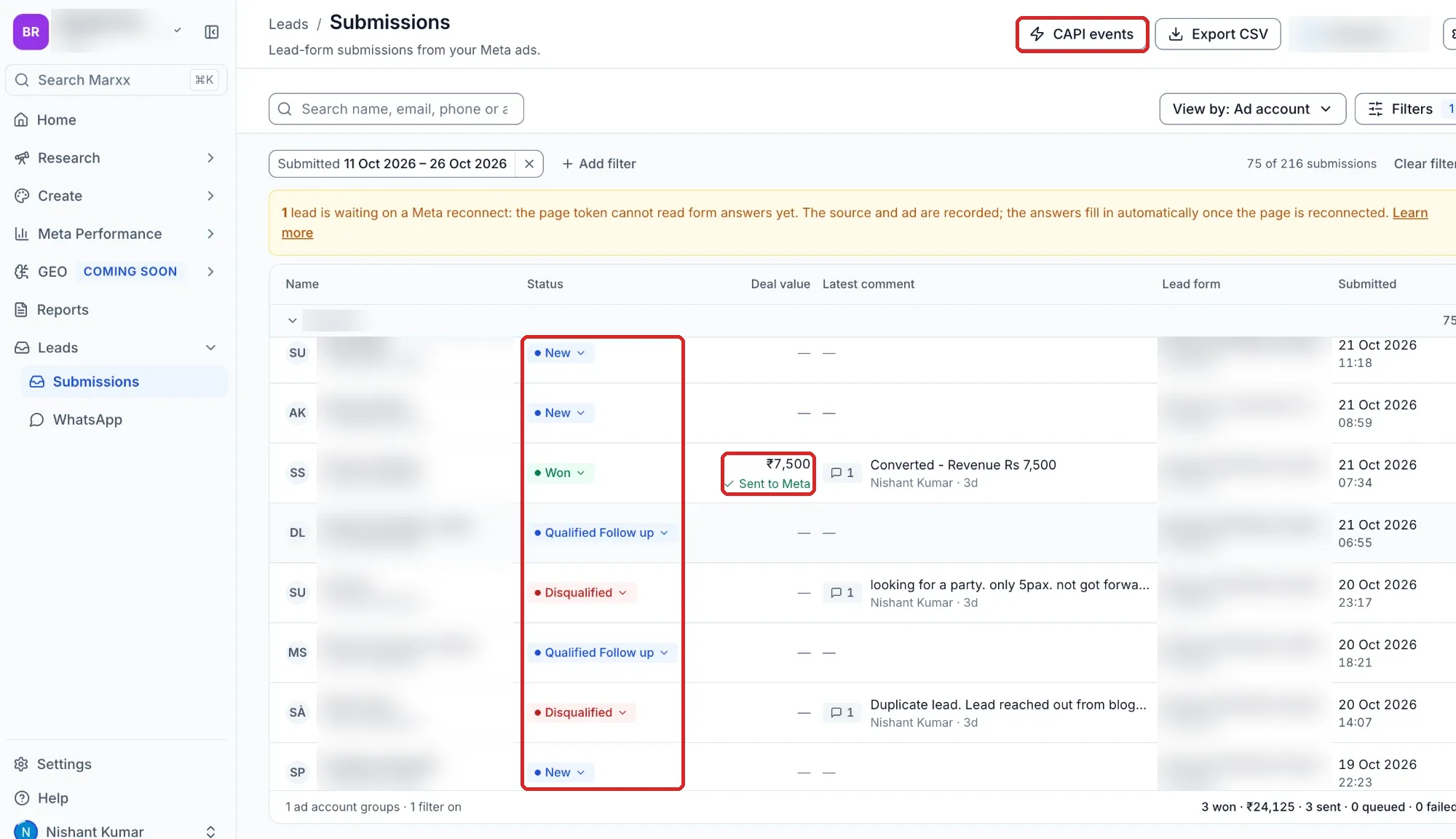
- Every lead lands in one place. Leads from Meta lead forms flow into the Leads tab of Marxx AI, which works as our CRM. Any CRM that stores the Meta lead ID will do. Each row shows the lead’s status, the deal value, the latest comment and which form it came from.
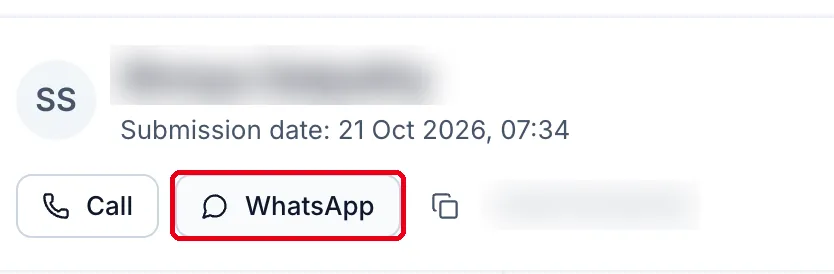
- The team works the lead from the same screen. Open a lead and call or WhatsApp them in one click. Every call and note is logged against the lead, so whoever picks it up next knows where it stands.
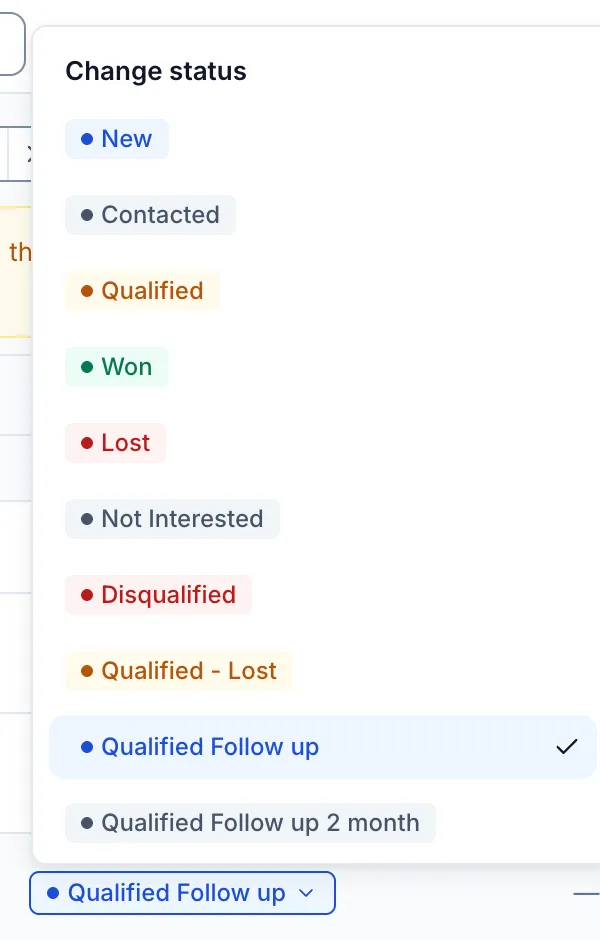
- Every lead gets a status. New, contacted, qualified, qualified follow-up, won, lost, not interested, disqualified. Use whatever stages match how you sell. The status is not admin. It is the training data.
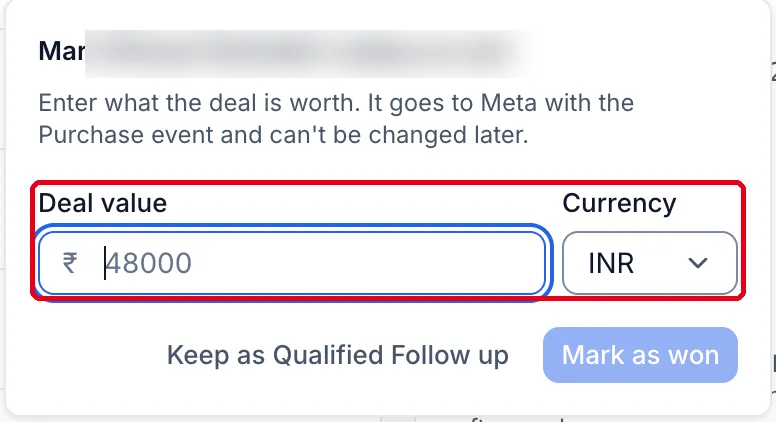
- Won leads carry a value. When a lead buys, the team enters what the deal is worth. It goes to Meta with the Purchase event, so Meta can tell a ₹48,000 customer from a ₹4,800 one.
- Each status change goes back to Meta through the Conversions API, automatically. The won lead in the first screenshot shows it: ₹7,500, sent to Meta.
- The campaign optimises for the stage that pays: qualified lead or purchase, whichever has the volume.
What happens when Meta learns from purchases?
The campaign stops chasing tappers and starts chasing buyers. Cost per lead usually goes up. Cost per customer goes down, and the sales team spends its day on people who intend to buy.
On one of our accounts, here is what changed when we moved the campaign from optimising for the lead to optimising for the qualified lead.
| Optimised for leads | Optimised for qualified leads | |
|---|---|---|
| Cost per lead | ₹200 | ₹250 |
| Leads that converted | 10% | 30% |
| Cost per customer | ₹2,000 | ₹833 |
Each lead cost 25% more. Three times as many of them bought, so cost per customer fell by more than half, from ₹2,000 to ₹833. Cost per customer is cost per lead divided by the conversion rate.
The important difference is that the campaign keeps improving. Every purchase you log makes the next week’s leads better, and that is what lets a lead campaign scale without hiring a bigger sales team.
How do you start?
Connect your Meta lead forms, mark your next ten leads as they move, and let Meta see what happens to them. You can set this up yourself in the Marxx AI leads CRM: start for free. If you would rather we look at your account first, book a demo with Nishant below.
More on measurement and budgets sits under paid media and scaling with ads.
Ask me anything about this post
Frequently asked questions
Why are cheap WhatsApp leads a problem?
Because the only thing Meta learns is who will tap a button. It never hears which of those people bought, so it keeps finding more of the cheapest tappers. Your sales team carries the cost: more people calling more junk, and a lead volume that cannot scale without more headcount.
What is the Conversion leads goal on Meta?
It is a lead ad performance goal that optimises for a later stage in your funnel, such as a qualified lead, instead of the form submission. You send the stage changes from your CRM to Meta through the Conversions API. Meta says it currently works with Instant Forms.
How many leads do you need for this to work?
Meta's own guide suggests at least 200 leads a month, CRM data uploaded at least daily, and a target stage that converts between 1% and 40% of leads. Below that, optimise for a stage nearer the form.
Why send the purchase value, not just the purchase?
So Meta can tell a ₹5,000 customer from a ₹50,000 one. With value attached, the campaign can bid for the people who spend more, not just the people who buy at all.
Sources
- Conversions API for CRM Integration — Meta for Developers, accessed 26 Oct 2026
- Meta's guide to better lead quality — Zapier, accessed 26 Oct 2026
Related reading
-
Meta's Customer Lifecycle Strategy: stop paying for customers you have
Meta's Customer Lifecycle Strategy lets you mark an ad set as acquisition and exclude existing customers. How it works and how to feed it good data.
-
Meta shows results per creative asset. Here's how to read it.
Ads Manager's Creative breakdown shows results for each image, video and headline. How to find it, what it hides, and when to act on it.
-
Andromeda 2.0, GEM and GenRecs: what Meta's ad AI means for creative
What Meta's ad systems Andromeda, GEM and generative retrieval actually do, what changed in 2026, and why distinct creative concepts now beat more ads.
Ask this site
Answers are generated from published posts on this site only. Check the cited post before acting on anything.