Meta's Customer Lifecycle Strategy: stop paying for customers you have
It is a setting, open to all advertisers since October 2026, that lets you mark an ad set as acquisition so Meta suggests excluding existing customers. It only works as well as your customer data: define existing customers and engaged audiences in Advertising settings, keep the lists fresh, and run a separate campaign for repeat buyers.
A lot of “new customer” ad spend goes on people who already bought from you. They see the ad, they click, they buy again, and the campaign takes the credit for a customer you already had. Your cost per new customer looks healthy. It is not.
On 6 October 2026, Meta made a setting called Customer Lifecycle Strategy available to all advertisers to tackle exactly this. In Meta’s words: “When marketers launch acquisition campaigns, they want to find new customers, not existing ones.”
What does it do?
You tell Meta that an ad set is for acquisition, and Meta recommends how to exclude your existing customers, “instead of building those exclusions from scratch.” Meta says it is also testing a way to exclude a whole group of existing customers with a single audience label.
Guides that have used it describe the choice at ad set level: acquire new customers, with a further choice between people who have engaged with you but not bought and people who have not engaged at all, or reach both. Meta has not published a help page with the exact labels, so check what your account shows.
How does Meta know who your customers are?
From you. This is the part most accounts get wrong. Meta splits everyone into three segments, and you define two of them in Advertising settings:
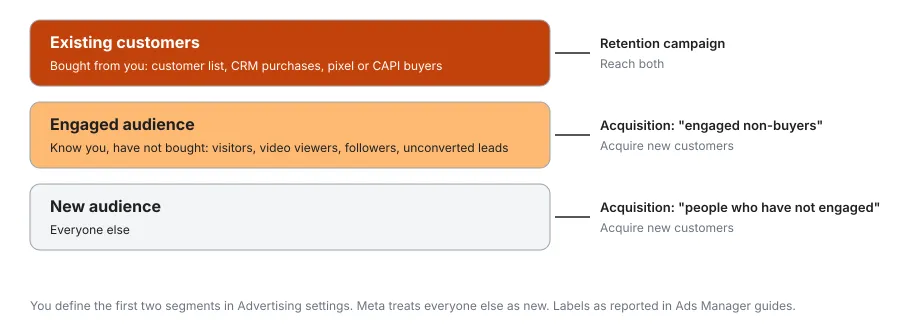
- Existing customers: your customer list, website and app purchasers, CRM purchases sent through the Conversions API.
- Engaged audience: people who know you but have not bought, such as site visitors, video viewers, followers and leads who never converted.
- New audience: everyone else.
Once these are set, you can also see results split by segment under Breakdown → Audience segment, so you know how much of your spend actually reached new people.
Why does it go wrong?
Because Meta can only exclude people it can match. Three things let past buyers slip through as “new”:
- Stale lists. A customer list uploaded once, a year ago, misses everyone who bought since. Refresh it, ideally automatically.
- Thin data. Lists without phone numbers, or a pixel and Conversions API that miss purchases, match fewer people. Check the match quality in Events Manager.
- Over-exclusion. Exclude too broadly and you lose people who were about to buy, or customers of a different product line you do want to reach.
When this happens, new-customer cost and new-customer ROAS look better than reality. Trust the numbers only after you have checked the lists behind them.
How should a lead business use it?
The same way, with one extra step. A lead business’s customer list lives in its CRM, not its pixel. Every lead you mark as won is an existing customer Meta should stop paying to reach.
That is why we feed won leads back to Meta, as we describe in teaching Meta which leads are good. In our own set-up, the Marxx AI leads CRM records every lead’s status and sends purchases to Meta, so the existing-customer segment stays current without anyone uploading a spreadsheet. You can start for free.
What should you set up this week?
- Define your segments. In Advertising settings, set Existing customers (customer list plus purchasers) and Engaged audience (visitors, viewers, unconverted leads).
- Fix the data. Refresh the customer list, add phone numbers, and check purchase events reach Meta through the Conversions API.
- Split the jobs. Mark prospecting ad sets as acquisition. Run a separate, smaller campaign for existing customers, with offers made for them.
- Check the breakdown weekly. Use the audience segment breakdown to see what share of spend reaches new people, and whether it moves after the change.
Meta has published no results for Customer Lifecycle Strategy, so measure your own: new-customer cost before and after, on lists you trust. And if it means fewer ad sets, see how many your budget can feed in Meta’s 50 conversions a week.
Ask me anything about this post
Frequently asked questions
What does Customer Lifecycle Strategy do?
In Meta's words, marketers "can specify that a campaign is acquisition and will receive recommendations on how to exclude existing customers, instead of building those exclusions from scratch." Meta made it available to all advertisers on 6 October 2026.
How does Meta know who my existing customers are?
From what you give it. In Advertising settings you define Existing customers and Engaged audience using custom audiences such as customer lists, website purchasers and engagement audiences. Everyone else counts as new.
Why do returning buyers still show up as new customers?
Because Meta can only exclude people it can match. Old customer lists, missing phone numbers and gaps in pixel or Conversions API purchase data all let past buyers slip through as new, which makes new-customer costs look better than they are.
Does it work for lead generation?
Yes, if your CRM knows who has already bought. Upload or sync your customers, and your won leads, as the Existing customers segment, so acquisition campaigns stop paying to reach people who are already clients.
Sources
- Advertising Week New York 2026: new AI capabilities — Meta Newsroom, accessed 10 Nov 2026
- Audience segments in manual sales campaigns — Jon Loomer Digital, accessed 10 Nov 2026
- Meta customer lifecycle strategy for all advertisers — Common Thread Collective, accessed 10 Nov 2026
Related reading
-
Meta shows results per creative asset. Here's how to read it.
Ads Manager's Creative breakdown shows results for each image, video and headline. How to find it, what it hides, and when to act on it.
-
Optimising Meta for leads is the most expensive cheap thing you can do
Cheap leads teach Meta nothing. How we send qualified and purchase events back through the Conversions API so Meta learns which leads actually buy.
-
Andromeda 2.0, GEM and GenRecs: what Meta's ad AI means for creative
What Meta's ad systems Andromeda, GEM and generative retrieval actually do, what changed in 2026, and why distinct creative concepts now beat more ads.
Ask this site
Answers are generated from published posts on this site only. Check the cited post before acting on anything.